

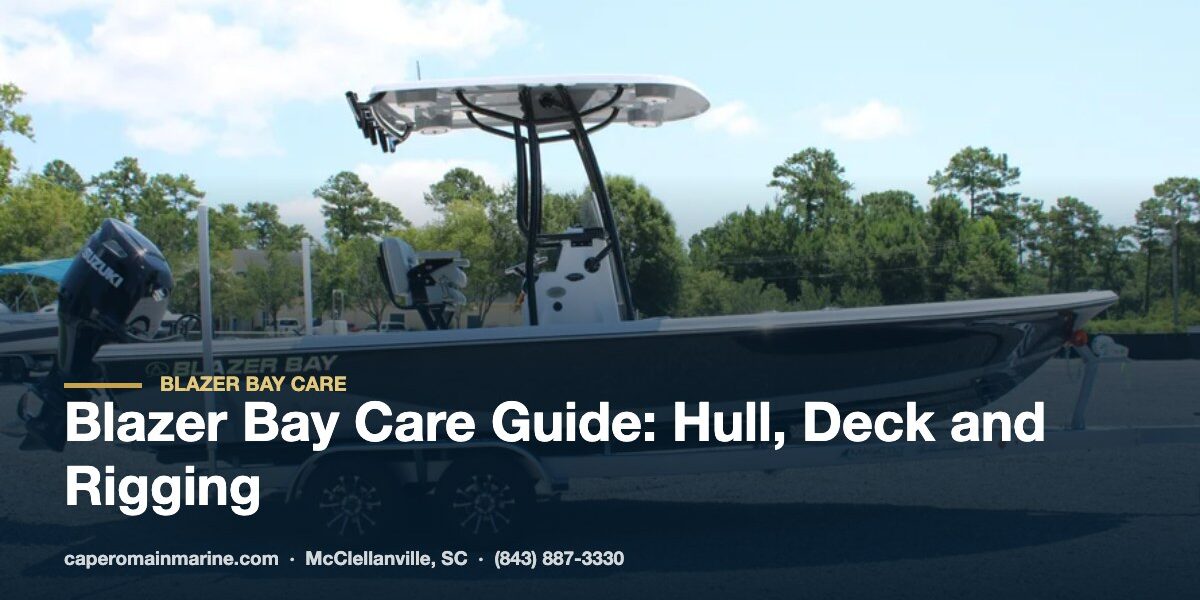
A Blazer Bay is built to take the Lowcountry, but the boats that still look and feel right after ten seasons are the ones whose owners did small, unglamorous things consistently. The engine gets most of the maintenance attention. The hull, deck and rigging are what determine whether the boat is still a pleasure to use, and what it is worth when you sell it.
Blazer builds with 100 percent composite construction, so you are not fighting rot in the structure the way you would on an older wood-cored hull. That removes the biggest long-term worry and leaves you with a straightforward list.
Rinse the whole boat, not just the engine
Most owners are good about flushing the motor and then coil the hose. Salt is just as hard on everything else.
Rinse the deck, the console, the T-top, the hardware, the rod holders, the trailer and the underside of the hull. Pay attention to the places salt collects and does not rinse out on its own: hinges, latches, hatch gutters, the trolling motor mount, under the leaning post, and inside rod holders.
Ten extra minutes with a hose after each trip does more for a boat’s condition over a decade than any single thing you can buy.
Gelcoat: wash, wax, and stay ahead of oxidation
Gelcoat is a surface, and in South Carolina sun it is under constant attack.
- Wash with a proper marine boat soap. Household detergents strip wax.
- Wax twice a year, spring and fall. This is the step that keeps oxidation from starting.
- Deal with oxidation early. Chalky, dull gelcoat can usually be brought back with a light compound and polish. Left long enough it goes past what polishing can fix.
- Keep it covered. UV is the primary enemy. A cover or a roof is worth more than any product you can apply.
Our post on why detailing matters more in saltwater goes deeper on this.
Non-skid needs different treatment
Non-skid works because of its texture, and that texture holds dirt. It needs a soft deck brush and agitation rather than a rinse.
What it does not need is aggressive pressure washing or harsh abrasives, both of which wear the texture down over time. Once non-skid is polished smooth it is slippery when wet, which is the opposite of the point. Wax belongs on smooth gelcoat, not on non-skid, for the same reason.
Hardware, hatches and fasteners
Stainless steel is corrosion resistant, not corrosion proof, and in salt air it will show surface rust. Wipe it down, rinse it, and use a stainless cleaner or protectant periodically.
Work the hatch hinges, latches and any moving hardware and treat them with a marine lubricant. A latch that gets sticky and then gets forced is a latch that breaks. Check that hatch gutters drain freely, since a blocked gutter puts water where the design intended it not to go.
If you ever notice water intruding around a fitting, deal with the bedding sooner rather than later. Composite construction means you are not risking rot, but you still do not want standing water in a compartment.
Livewells, pumps and plumbing
The livewell is the most common source of a smell that owners cannot locate.
- Drain it fully after every trip, rinse with fresh water, and leave the lid open to dry.
- Flush the plumbing and the pump, not just the tank. Organic material sits in the lines.
- Check and clean the pump screens and any strainers.
- Periodically run fresh water through the whole system to clear salt out of the pumps.
Same principle for washdown pumps and the raw water system.
The bilge and the bilge pump
Keep the bilge clean and dry. Check that the pump runs and that the float switch actually triggers, which is a separate test from the manual switch working. Make sure the discharge is clear.
A bilge pump that has never been tested is a bilge pump you should not rely on. Test it at the start of every season.
Upholstery, T-top and canvas
Marine vinyl handles sun and salt well but not indefinitely. Rinse it, clean it with a product made for marine vinyl, and apply a UV protectant a few times a season. Avoid harsh cleaners and anything containing bleach, which breaks down the material and the stitching.
Rinse T-top canvas and covers, let them dry fully before storing, and re-treat with a water repellent when water stops beading. A cover put away damp is a cover that grows mildew.
Electronics, wiring and the trolling motor
Salt air finds every connection.
- Check terminals and connectors for corrosion, particularly at the battery, the trolling motor plug and the console.
- Use dielectric grease on connections that are exposed.
- Rinse displays with fresh water and cover them when the boat sits.
- Keep batteries charged and terminals clean. Most electrical gremlins are connection problems, not component failures.
- Rinse the trolling motor after saltwater use, including the shaft, and check the mount hardware for looseness.
What to check every season
Once a year, go over the things you do not look at day to day: steering for stiffness or play, jack plate operation, trim tabs, the transom around the engine mount, the anchor locker drain, safety gear expiry dates, and every through-hull and hose clamp you can reach.
If you would rather have someone else do it, that is what our service department is for. We can look over the boat as well as the engine, and for owners around Charleston and Mount Pleasant we can often come to the boat through our mobile service.
Why this pays off
Beyond the obvious, condition is most of what determines resale value on a used bay boat. Two identical Blazer Bays of the same year and hours can be separated by a wide margin purely on how they present, because a buyer reads a well-kept boat as a well-maintained boat, and they are usually right.
If you are weighing a trade or an upgrade, we handle trade valuations and carry the current Blazer Bay lineup, which runs from the PureBay 2200 at just over 21 feet to the Makaira 2800 at just over 27 feet. For questions about what the factory warranty covers, see our post on the Blazer warranty.
We are at 10129 US-17 in McClellanville. Call (843) 887-3330.
Frequently Asked Questions
How often should I wax a Blazer Bay boat in South Carolina?
Twice a year is the practical target in the Lowcountry, usually spring and fall, because our UV load and salt exposure are higher than average. A boat kept on a lift or covered outdoors may need it more often than one stored under a roof.
Do Blazer boats have wood in the hull?
No. Blazer builds with 100 percent composite construction, so there is no wood in the structure to rot. You still want to keep water out of compartments and hardware bedding, but you are not fighting a wet stringer or transom core the way you would on an older wood-cored hull.
What is the best way to clean non-skid on a boat deck?
A soft deck brush, a marine boat soap and fresh water handles most of it. Non-skid holds dirt in its texture, so it needs agitation rather than just rinsing. Avoid harsh abrasives and heavy pressure washing, which wear down the texture and cost you the grip.
How do I keep my livewell from smelling?
Drain it completely after every trip, rinse it with fresh water, and leave the lid open so it dries. Most livewell odor comes from organic material left in the plumbing and pump, so flushing the whole system rather than just the tank is what solves it.
Does the Blazer warranty cover normal wear items?
Blazer’s limited warranty covers structural and manufacturing defects, not routine wear, cosmetic damage or maintenance items. The engine carries its own separate manufacturer warranty.