

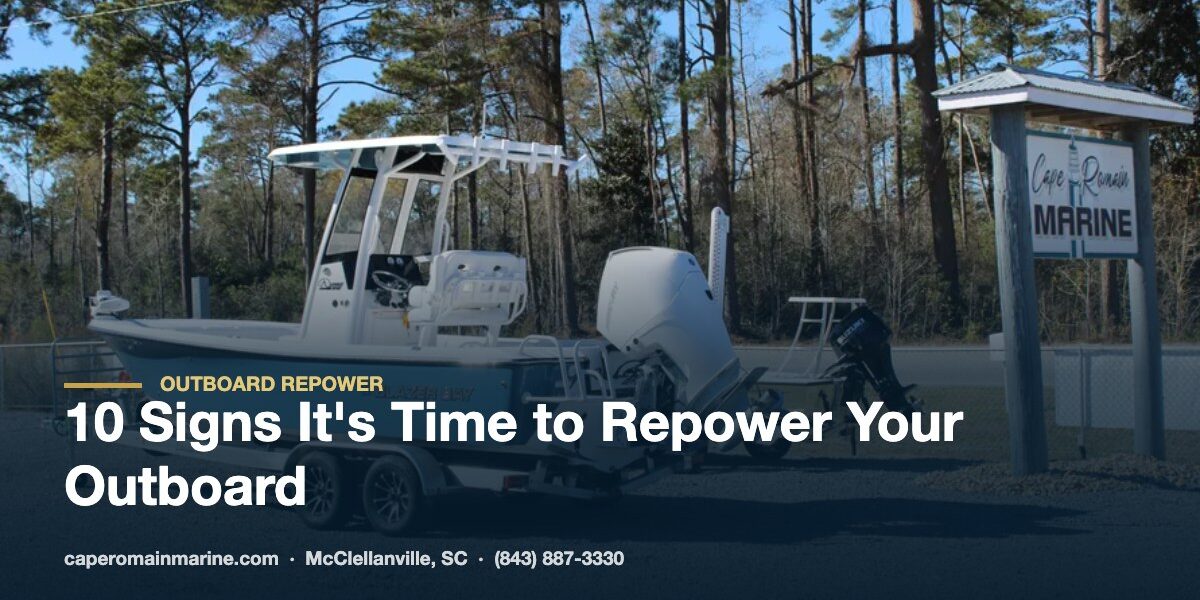
If you are asking whether it is time to repower, the answer usually comes down to one question: are you spending money to keep an engine running, or spending money to make it better? Once repairs stop being maintenance and start being resuscitation, a repower is almost always the better use of the same dollars.
We have been repowering boats at our shop in McClellanville since 2007, and these are the signals we tell owners to watch for.
1. The repair bills are stacking up
One repair is maintenance. Three in a season is a pattern. When you have spent a meaningful chunk of what the engine is actually worth in the last twelve months, and the next item on the list is a lower unit or a powerhead, you are funding an engine that will never be worth what you put into it.
2. Parts are getting hard to find
This is the quiet one that catches people out. When a model goes out of production, parts availability slowly dries up, and a repair that should take three days starts taking three weeks while a part comes from a salvage yard. We still service Evinrude outboards for owners around Charleston, but production ended in 2020, and every year the parts hunt gets a little harder. If your engine is out of production and you are keeping it for another five years, plan for that.
3. It has become a hard starter
An engine that needs coaxing on a cold morning, cranks and cranks before catching, or dies at idle when you pull back to trolling speed is telling you something. Sometimes it is fuel, plugs or a sensor, and it is worth chasing those first. Our post on why outboards will not start covers the usual culprits. When you have chased them and it still will not start clean, the engine is worn.
4. Compression is down or uneven
This is the most objective number in the conversation. A compression test across all cylinders tells you where the engine actually stands. Readings that vary noticeably between cylinders, or that have dropped since the last time it was checked, point at rings, valves or worse. Any shop can do this in under an hour, and it is worth doing before you spend anything else.
5. There is corrosion where it matters
Surface corrosion on a cowling is cosmetic. Corrosion on the midsection, at the transom bracket, around the mounting bolts, or inside the powerhead is structural. Saltwater boats in the Lowcountry live a hard life, and an engine that was not flushed consistently will show it in places that are expensive to fix.
6. It smokes, burns oil, or the oil looks wrong
Blue smoke that does not clear, oil consumption that climbs season over season, or milky oil on the dipstick all point to internal wear or water intrusion. Milky gear oil specifically means the lower unit seals have failed and water is getting in, which will destroy a gearcase quickly if it is ignored.
7. You have lost top end and it struggles to plane
If the boat takes longer to get up, will not hold plane at the speed it used to, or has lost several miles per hour off the top with the same load and the same prop, the engine is not making the power it once did. Rule out a damaged prop and a fouled bottom first, then look at the engine.
8. Your fuel burn keeps climbing
Older two-strokes were thirsty by design, and a worn engine of any type burns more than a healthy one. Modern four-strokes from Yamaha, Suzuki and Mercury are dramatically more efficient than what they replaced. For owners running long distances to the Cape Romain jetties or down to Bulls Bay, the fuel savings alone change the math on a repower more than most people expect.
9. You plan your trips around the engine
This one is not on any diagnostic sheet, but it is the sign that matters most. If you stay inshore because you do not trust the motor offshore, skip the long run because you are not sure it will start after lunch, or bring a second person mainly so somebody can help if it quits, the engine has already changed how you use the boat.
10. The hull is still good and you still like it
The best candidate for a repower is a boat you are not ready to give up. If the hull, deck and transom are sound and the layout still suits how you fish, a new engine gives you most of the experience of a new boat for a fraction of the cost. That is a genuinely good outcome, and it is why we do so many of them.
When a repower is not the answer
There are boats we advise people not to repower, and we would rather say so before you spend anything.
- A soft or flexing transom. The transom carries the entire thrust and weight of the engine. Cracks around the bracket, visible flex under load, or water weeping from the mounting bolt holes mean structural repair comes first.
- Soft spots in the deck. Usually a sign of a wet core, and rarely confined to the spot you can feel.
- A waterlogged hull. If the boat sits noticeably lower and is slower than it was when it was new with the same power, the foam may be saturated. Hanging a new engine on it will not fix the handling.
- The math does not work. If the repower plus the necessary repairs approaches what the boat is worth, you are better off looking at a pre-owned boat or a new one. Our post on repowering versus buying new works through that decision in more detail.
What to do next
Start with facts rather than a guess. A compression test, a lower unit inspection, a look at the transom and a review of the service history will tell you where you actually stand. From there the decision is usually obvious.
We repower with Yamaha, Suzuki and Mercury, and we handle the whole job in house, including controls, gauges, steering and rigging. If you want an honest read on whether your boat is worth repowering, bring it by 10129 US-17 in McClellanville or call (843) 887-3330. If the answer is no, we will tell you.
Frequently Asked Questions
How many hours is too many for an outboard?
There is no fixed number. A well-maintained four-stroke can run 2,000 to 3,000 hours or more, while a neglected engine can be finished at 700. Hours matter far less than service history, how consistently the engine was flushed after saltwater use, and what a current compression test shows.
Is it cheaper to rebuild an outboard or repower?
A rebuild is usually cheaper up front, but you end up with an old engine, an old harness, old controls and no meaningful warranty. A repower resets all of that and typically carries a multi-year factory warranty, which is why most owners with a sound hull choose to repower.
Can I put a bigger engine on my boat when I repower?
Only up to the horsepower shown on your boat’s capacity plate. Exceeding that rating is unsafe and will cause problems with insurance. You can often gain real performance within the rating by moving to a modern engine with a better gearcase and the right prop.
How long does an outboard repower take?
Most single-engine repowers take a few days to about a week of shop time once the engine is on hand, depending on whether controls, gauges, steering and rigging are being updated at the same time. Engine lead time is usually the longer part of the wait.
What are the warning signs that a boat should not be repowered?
A soft or flexing transom, water intrusion in the transom core, soft spots underfoot on the deck, or a waterlogged hull. Those are structural problems that have to be corrected before a new engine goes on, and the repair can cost more than the boat is worth.