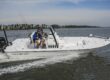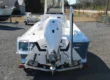

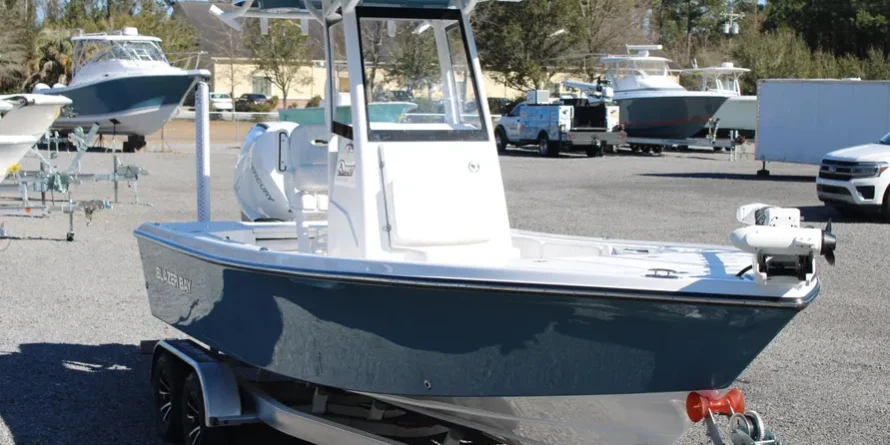
If you have spent any time browsing bay boats, you already know the options can start to blur together. Most bay boats share the same basic idea: a shallow-draft hull, a wide-open casting deck, and just enough freeboard to handle a little chop without giving up the ability to pole across a skinny flat. So what actually separates one brand from another? We get this question constantly from folks cross-shopping Blazer against other bay boat builders, and the honest answer is that the differences show up in the details rather than in the marketing copy. Here is how we walk customers through that comparison when they visit us in McClellanville.
What Makes a Bay Boat a Bay Boat
Before comparing brands, it helps to define the category. A bay boat sits between a flats skiff and a full center console. It is built to run skinny water and pole quietly over grass and oyster rock, but it still needs enough hull to handle open sounds and nearshore chop on the way to and from the fishing grounds. That balancing act is the whole design challenge, and every builder solves it a little differently. Some lean toward a softer ride in rough water at the expense of shallow-water performance. Others chase the shallowest possible draft and accept a firmer ride offshore. Understanding where a brand lands on that spectrum tells you almost everything you need to know before you ever step aboard.
Hull Design: Where the Ride Really Comes From
Blazer builds its bay boats around a modified-vee hull with a moderate deadrise and a pad running down the center of the transom. That pad helps the boat get on plane quickly and hold a stable, efficient cruise without demanding a huge amount of horsepower. Compared to some competing hulls that use a flatter bottom for the shallowest possible draft, the Blazer hull gives up a small amount of draft in exchange for a noticeably softer ride once you are running across open water. In practice, that means less pounding on a windy afternoon coming back from the beach or an outer reef, without sacrificing the ability to pole up on a school of reds in eighteen inches of water. Other brands in this class sometimes ask you to choose one extreme or the other. Blazer’s approach is aimed squarely at the middle, which is where most Lowcountry anglers actually spend their time.
Fit, Finish, and Build Quality
Once you get past the hull, the next place brands separate themselves is in the details you touch every trip. Wiring runs, hatch gasketing, hardware quality, and gelcoat finish all vary quite a bit across builders, and those differences only become obvious after a season or two of saltwater use. Blazer has built a reputation for tight tolerances on hatches and doors, marine-grade wiring with properly heat-shrunk connections, and a gelcoat finish that holds up well to sun and salt without chalking prematurely. We have serviced boats from several different bay boat manufacturers over the years, and the difference in how a five-year-old boat holds up often comes down to these unglamorous construction details rather than anything you would notice on the showroom floor.
Deck Layout and Fishability
A bay boat lives or dies by its deck. Blazer’s layouts favor a genuinely open front casting deck with minimal clutter, forward and aft livewells sized for real bait loads rather than token tank space, and enough rod storage that you are not stepping over gear between the console and the leaning post. Compared to some competitors that squeeze in extra seating or storage at the expense of open deck space, Blazer tends to protect that casting area even on its smaller models. If you fish with a partner and actually need room to move and cast without tangling lines, that layout philosophy matters more than an extra cooler seat or cup holder ever will.
Power Options and Performance
Blazer hulls are rigged with Yamaha, Suzuki, or Mercury outboards, and the boats are engineered to run well across a wide range of horsepower within each model’s rating. That flexibility lets us match the boat to how you actually fish rather than forcing a single power package on every buyer. Where Blazer tends to separate itself from some other brands is efficiency at cruise. Because the hull is not fighting extra weight or a poorly matched pad design, owners consistently report strong fuel economy in the 3,500 to 4,500 RPM range where most of us spend our running time. That translates directly into more range on a tank of fuel and lower cost per trip over the life of the boat.
Price and Value for the Money
Sticker price comparisons across bay boat brands can be misleading unless you look closely at what is actually included. Blazer tends to include a strong standard equipment list — items like a quality trolling motor mount, functional livewells, and solid hardware — that other brands sometimes push into optional packages. When you compare two boats with similar base prices, it is worth adding up what it would actually cost to equip a competing hull the way a Blazer comes standard. In our experience, that comparison usually favors Blazer once you account for the options most anglers end up wanting anyway.
Resale Value and Reputation in the Lowcountry
Blazer is a newer name to some South Carolina anglers, even though the company has been building boats for years, and we are proud to be one of the dealers bringing that lineup to the Lowcountry. What we have seen so far mirrors the trend in other regions where Blazer has been established longer: strong owner satisfaction, low warranty claim rates, and resale values that hold up well against more established regional brands. A big part of that comes down to the build quality we mentioned earlier. Boats that do not develop rattles, soft spots, or electrical gremlins after a few seasons simply sell better used, and that protects your investment whether you plan to keep the boat for two years or twenty.
Which Boat Fits the Way You Fish
None of this means Blazer is automatically the right choice for every angler, and we will tell you that honestly if another hull fits your needs better. If you fish exclusively in ultra-skinny water and rarely run more than a mile or two, a dedicated flats skiff with a shallower draft may serve you better. If you spend most weekends running well offshore, a deeper center console is a more appropriate platform. But for the large number of Lowcountry anglers who split their time between skinny water for reds and trout and longer runs to nearshore structure, the balance Blazer strikes between shallow-water capability and open-water ride is hard to beat. That versatility is exactly why we chose to bring the brand into our lineup.
See the Difference for Yourself
Specs and comparisons only tell part of the story. The real test is standing on the deck and running the boat yourself. Stop by Cape Romain Marine in McClellanville and take a look at our current Blazer bay boat lineup, and we will happily walk you through how the hull, layout, and rigging compare to whatever else you are considering. And once you own one, our factory-trained boat service team is right here in McClellanville to keep it running the way it did on day one.
Frequently Asked Questions
Is a Blazer bay boat better than other bay boat brands?
“Better” depends on how you fish. Blazer strikes a strong balance between shallow-water capability and a soft ride in open water, along with a strong standard equipment list. For anglers who split time between skinny water and longer runs, that balance is a real advantage over brands built toward one extreme or the other.
How does Blazer’s ride compare to other bay boats in rough water?
Blazer’s modified-vee hull with a center pad tends to ride softer in chop than flatter-bottomed competitors, while still holding a shallow enough draft for skinny-water fishing. It is a middle-ground design rather than an extreme in either direction.
Are Blazer boats good for resale value?
Yes. Strong build quality, tight tolerances, and durable wiring and hardware have translated into solid owner satisfaction and resale value in regions where Blazer has been established, and we are seeing the same trend here in the Lowcountry.
What engines can be rigged on a Blazer bay boat?
Blazer hulls are commonly rigged with Yamaha, Suzuki, or Mercury outboards. We can help you match horsepower and brand to your budget, fishing style, and service preferences.
Where can I compare a Blazer bay boat in person?
You can see our current lineup and take a test drive at Cape Romain Marine in McClellanville, SC. We will walk you through the hull design, layout, and rigging so you can compare it directly against other brands you are considering.