
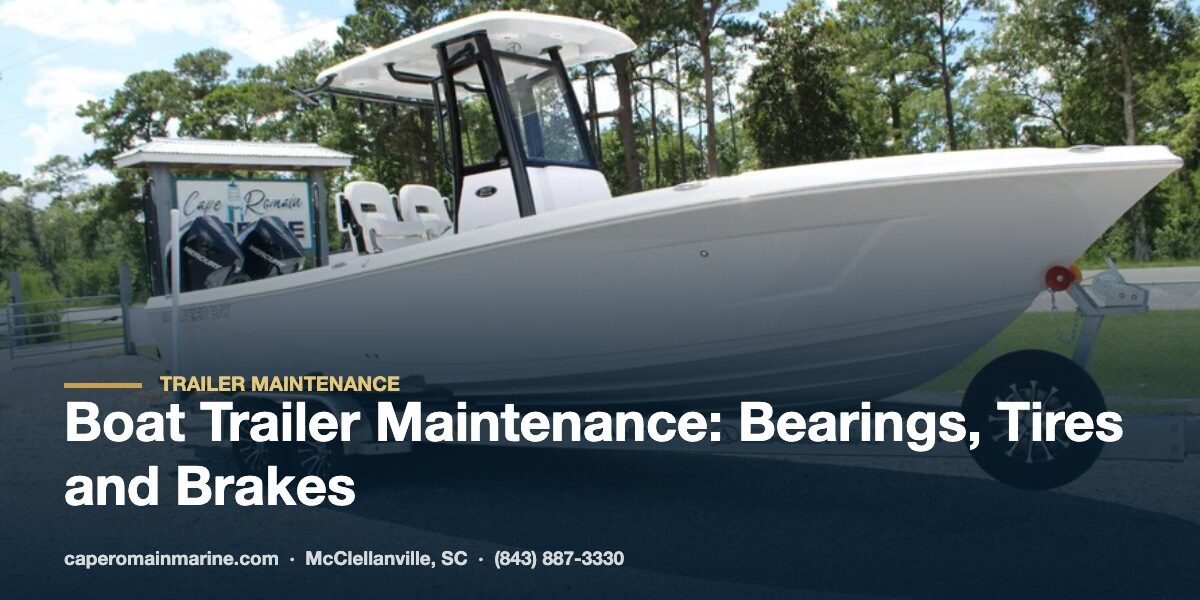
More boat days get ruined by trailers than by engines. The trailer sits outside all year, gets dunked in saltwater every trip, receives almost no attention, and then gets asked to carry several thousand pounds down US 17 at highway speed. It is the least maintained part of most boating setups and the one most likely to strand you.
Here is what actually needs doing, and how the Lowcountry changes the intervals.
Wheel bearings: the one that leaves you on the shoulder
Bearings are the number one cause of trailer breakdowns, and the failure mode is unforgiving. A bearing that runs dry gets hot, seizes, and can take the spindle with it. At that point you are not doing a roadside repair.
The physics work against you at every launch. Hot hubs from the drive get backed into cool water, the air inside contracts, and the resulting vacuum pulls water past the seals. Do that thirty times a season in salt and you understand why saltwater trailers need more attention than the manual assumes.
What to do:
- Inspect annually if you launch in salt, even though general guidance for repacking is every few seasons. Saltwater use is the hard case, not the typical one.
- Check hub temperature at every fuel stop on a long tow. Warm is normal. One hub noticeably hotter than the others is a warning.
- Check for play by rocking the tire at the top and bottom. Movement means the bearing is loose or worn.
- Look at the grease. Milky means water. Gritty means it has already been chewing on something.
- Use bearing protectors and keep them properly greased. They hold positive pressure in the hub so water is pushed out rather than drawn in.
- Carry a spare hub kit with bearings, races and seals. It costs little and turns a tow-truck day into an hour on the shoulder.
Tires: they age out before they wear out
Trailer tires spend most of their life parked in the sun, and that is what kills them. Tread depth is usually the last thing to go.
- Check pressure before every trip, cold. Use the number on the sidewall or the capacity sticker, often somewhere between 50 and 65 psi. Underinflation builds heat, and heat is what causes blowouts.
- Replace on age, roughly every five to seven years, regardless of tread. Find the DOT code on the sidewall for the manufacture date.
- Look for sidewall cracking, which is UV damage and means the tire is done.
- Use trailer-rated tires. Passenger car tires are not built for the sidewall loads a trailer imposes.
- Check the spare. It is the tire most likely to be flat when you need it, and check that you actually have the tools to change it.
- Cover the tires when the trailer sits for long periods.
Brakes
Most trailers capable of carrying a bay boat have surge or electric brakes, and both live underwater at every launch.
- Rinse brakes and wheels with fresh water immediately after a saltwater launch. Not the same evening. As soon as you can.
- Check hydraulic fluid seasonally. A sudden drop means a leak, which means finding it now.
- Have pads or shoes inspected every few seasons for wear and corrosion.
- Test the brakes early on every trip, somewhere safe and slow, before you need them.
- Watch for a surge actuator that sticks, which shows up as brakes dragging or the trailer pushing when you slow.
Lights and wiring
Trailer lights fail constantly, and it is almost always the same handful of causes: a bad ground at the white wire, a chafed wire shorting against the frame, corroded sockets, or a corroded connector plug.
Test the lights before every trip, with someone watching or against a wall. Use dielectric grease in sockets and on the plug. Replace corroded connectors rather than fighting them, and secure any wiring that hangs where it can rub. LED assemblies are sealed and hold up better in salt than older bulb fixtures.
Frame, springs and the rest
- Rinse the whole trailer after every saltwater launch, frame included. Salt sits in the frame channels where you cannot see it.
- Check springs, shackles and U-bolts for corrosion and cracks. Leaf springs rust from the inside out.
- Inspect the winch strap for fraying and the safety chain and hook for wear. A strap that fails at the ramp is a very bad day.
- Check bunk carpet and rollers. Worn carpet exposes staples and screws that will scratch the hull.
- Grease the coupler and the jack.
- Check that the safety chains cross under the tongue and are the right length, so the tongue is caught rather than dropped if the coupler releases.
Before every tow, in two minutes
Coupler latched and pinned. Safety chains crossed and attached. Lights working. Tire pressure and a look at all four tires. Winch strap tight and the transom straps on. Nothing loose in the boat. Drain plug status decided deliberately.
That is the whole list, and it catches the great majority of trailer incidents.
Where we come in
We stock Magic Tilt trailers, carry trailer parts, and handle bearing service and trailer repairs at our shop in McClellanville. If your trailer has not been looked at in a few seasons, or you are heading into hurricane season and want to be sure you can actually move the boat if you need to, that is worth an appointment. Our post on hurricane boat prep covers why that matters here.
Call (843) 887-3330 or see our boat service page. We are at 10129 US-17 in McClellanville, Monday through Friday 8:30 to 5:00. Need parts rather than service? Use our parts request form.
Frequently Asked Questions
How often should boat trailer wheel bearings be repacked?
Manufacturer guidance is commonly every three to five seasons, but that assumes typical use. A trailer dunked in saltwater at every launch should be inspected annually and repacked far more often than a freshwater trailer. Any sign of water in the grease means service now.
What are the signs of a failing trailer wheel bearing?
A hub noticeably hotter than the others after a drive, a rumbling or grinding noise that changes with speed, wheel play when you rock the tire at top and bottom, and grease that looks milky or gritty. Any of these means stop and check before towing further.
What tire pressure should a boat trailer run?
Use the pressure on the tire sidewall or the trailer capacity sticker rather than car tire logic. Trailer tires often call for 50 to 65 psi. Underinflation causes heat buildup, which is the most common cause of trailer tire blowouts.
Do boat trailer tires need replacing even if the tread looks fine?
Yes. Trailer tires usually age out before they wear out, because they spend most of their life parked. Most are replaced on a schedule of roughly five to seven years regardless of tread depth. Check the DOT date code on the sidewall for the manufacture date.
Should I rinse my trailer after launching in saltwater?
Every time, and as soon as possible. Rinse the frame, wheels, brakes, springs, lights and wiring with fresh water. Trailer brakes and bearings are submerged at every launch, and salt left on them is what turns a trailer into a maintenance problem.